




























Sustainability
Sustainability Approach
Board Statement
CLINT is committed to growing in a responsible manner, delivering long-term economic value, and contributing to the environmental and social well-being of our communities. The material ESG factors have been identified and are in line with the CLI 2030 Sustainability Master Plan (SMP). We have aligned ourselves to the CLI 2030 SMP and steered our efforts on a common course to maximise impact through building portfolio resilience and resource efficiency, enabling thriving and future-adaptive communities, and stewarding responsible business conduct and governance.
Governance and Oversight
The Trustee-Manager's Board of Directors (the Board) is responsible for overseeing CLINT's sustainability efforts and takes ESG factors into consideration in determining its strategic direction and priorities, and it has considered sustainability issues in CLINT's business and strategy, determined the material ESG factors and overseen the management and monitoring of the material ESG factors. The Board also approves the executive compensation framework based on the principle of linking pay to performance. The Trustee-Manager's business plans are translated to both quantitative and qualitative performance targets, including sustainable corporate practices and are cascaded throughout the Company.
Industry Recognition
CLINT's sustainability leadership continues to earn recognition from global indices. We attained the highest 5-star rating for standing investments in the 2025 GRESB Real Estate Assessment, improving our score by two points to 92 points, positioning us within the top 20% globally and ranked 19th among Asia's listed companies. We maintained our scoring of ‘A' in the 2025 GRESB Public Disclosure and our ‘A' rating for MSCI ESG Rating. Beyond these benchmarks, we were ranked 14th position in the REIT and Business Trust Category for Singapore Governance Transparency Index (SGTI) 2025. We are particularly proud of our inclusion in the 2025 Singapore Board Diversity Index, an achievement that recognises our commitment to diversity among 553 listed companies on the Singapore Exchange (SGX) and Catalist. CLINT is one of the 43 listed companies that exhibits exemplary diversity standards across four or more categories.
Environmental Performance and Sustainable Financing
We remain committed to minimising our carbon footprint and embedding sustainability practices across all facets of our operations. Sustainability-linked loans (SLLs) now constitute 56%* of our total debt portfolio as at 31 December 2025. This year, we secured an onshore sustainability-linked construction loan for our data centre under development in Chennai, and also signed a SLL in successfully re-financing the construction loan for MTB 6 in ITPB. By aligning our financing structure with environmental performance targets, we demonstrate our conviction that responsible growth and commercial success are intrinsically linked. Energy management remains central to our environmental agenda and a key driver of portfolio resilience. In FY 2025, our portfolio continued to make steady progress in improving energy efficiency and increasing the share of renewable energy in our operations. In March 2025, we commissioned a 401-kilowatt-peak rooftop solar installation at our ITPH Block A facility, expanding our distributed renewable energy infrastructure. This installation is projected to generate approximately 490,000 kWh and reduce carbon emissions by 354 tCO2e annually. Complementing our efforts in renewable energy deployment, we are in an advanced stage of implementing an Energy Monitoring System at ITPH in Hyderabad. This system tracks, records and analyses realtime energy consumption across the facility, providing granular visibility into energy usage patterns. This enables us to make data-driven decisions for energy optimisation while facilitating early detection of equipment inefficiencies and consumption anomalies. Our efforts across CLINT's portfolio continue to yield tangible results. In FY 2025, we have reduced our energy consumption intensity by 32% against our 2019 baseline, surpassing our 15% reduction target. We also achieved 57% of electricity consumption from renewable energy across the portfolio, which exceeded our goal of 45%.
Community Impact and Social Responsibility
Beyond our environmental performance, CLINT maintains an unwavering commitment to supporting the communities in which we operate. Since its establishment in 2019, CapitaLand Hope Foundation (CHF) (India) has maintained a strong commitment to building resilience in communities, benefitting more than 4,870 children across five cities in India. In 2025, we continued to expand our impact through school construction and refurbishment and long-term engagement with project partners to improve educational outcomes for children. During the year, we completed the transformation of two schools in Chennai, creating child-friendly and contemporary learning environments that will enhance educational experience for students. Three additional Hope schools are currently under construction in Bangalore, Chennai and Pune, reflecting our sustained commitment to expanding quality educational infrastructure. Our partnership programmes deliver equally meaningful impact through long-term engagement. The Pratham-Hamara Gaon Project strengthens foundational literacy and numeracy skills for children in rural Bangalore, while the Unext-Youth Skilling Project provides soft skills training to youth from underprivileged backgrounds, to improve their employability and career readiness. The progress we have made this year strengthens our resolve to build upon these foundations. We remain committed to advancing our sustainability agenda with the same rigour and dedication that has defined our approach thus far, ensuring that CLINT continues to set meaningful benchmarks for responsible business.
-
Governance Structure

-
Materiality and Stakeholder Engagement
-
Materiality
CLINT's materiality assessment serves as the foundation for identification and prioritisation of material ESG issues based on relevance and significance to the Trust and its stakeholders. Guided by a double materiality approach, we evaluate topics from both impact and financial perspectives. Potentially material ESG issues arising from activities across CLINT and CLI's value chain (including potential risks and opportunities in the immediate and longer term) are primarily identified via ongoing engagement with CLINT's management, CLI's business units and external stakeholders. Additionally, there is a review of resources including investor questionnaires, ESG surveys, sustainability benchmarks and frameworks such as GRESB and IFRS S2 Industry-based Guidance on implementing Climate-related Disclosures (Volume 36 - Real Estate).
CLINT conducts regular review, assessment, and feedback in relation to ESG topics. The key component is an annual Groupwide Risk and Control Self-Assessment exercise which entails the identification, assessment and documentation of material risks and corresponding internal controls. These material risks include fraud and corruption, environmental (e.g., climate change), health and safety, and human capital risks which are critical pillars of our sustainability agenda.
Material issues are assessed and prioritised based on their likelihood and potential impact on business continuity. These topics are then organised into Build (Environmental), Enable (Social) and Steward (Governance) pillars in alignment with the CLI 2030 SMP, reflecting CLINT's sustainability agenda and forming the structure of this report.
In FY 2025, CLI and its listed funds undertook a comprehensive review of ESG material factors, benchmarking against global standards and emerging frameworks. While the core material topics remain robust, refinements were introduced to reflect evolving priorities. This included an emphasis on climate resilience (adaptation and mitigation) in response to heightened investor focus on climate-related risks and expansion of waste management to encompass circularity and upstream activities such as the use of recycled materials. In addition, natural capital has been integrated alongside biodiversity to natural capital in acknowledgement of the growing relevance of the Taskforce on Nature-related Financial Disclosures (TNFD) and anticipated ISSB S3 Disclosure Standards on Biodiversity, Ecosystems and Ecosystem Services.
Although Artificial Intelligence (AI) and Sustainable Financing were not identified as standalone material topics in this year's assessment, CLINT recognises their strategic importance. These emerging areas remain under close monitoring, with our approach to Sustainable Financing detailed under the Sustainable Finance section
Prioritisation of Material ESG Issues

-
Stakeholder Engagement


-
Materiality
-
Sustainability Performance and Commitment

-
Sustainability Commitment
CLI 2030 SMP was reviewed and endorsed by CLI's Board of Directors to ensure that its business strategy remains firmly aligned with climate science. As the cornerstone of CLI's sustainability agenda, the SMP drives progress across the ESG pillars, enabling CLI to create meaningful and lasting positive impact on both the environment and society.
As a CLI-sponsored Business Trust, CLINT is fully aligned with the SMP, reinforcing our shared commitment to advance global sustainability within the built environment. The SMP is anchored on three pillars: Build, Enable, and Steward. ‘Build' refers to environmental measures taken to improve portfolio resilience and resource efficiency. ‘Enable' refers to social commitments that CLI has taken for a thriving, future-adaptive community. ‘Steward' refers to governance commitments that will ensure responsible business conduct and governance within the organisation.
The SMP was designed to embed resilience throughout its operations and futureproof CLI's real estate portfolio, mitigate climate change risks, reduce the likelihood of premature obsolescence and position the business to seize adopt emerging opportunities. For more information, please refer to the SMP on the CLI website.
CLINT is committed to achieving the long-term 2050 Target of Net Zero emissions for Scope 1 and Scope 2 GHG emissions. CLINT will prioritise the decarbonisation levers below and source globally for new ideas and technologies to achieve higher energy efficiency and intensify its renewable energy integration efforts.

-
Sustainability Commitment
-
Sustainable Financing
Sustainable economic performance is essential to the responsible and efficient use of financial resources, contributing to long-term business viability. CLINT is committed to sustainable economic practices and strive to foster investor confidence, support ethical financial practices, and contribute to the overall well-being of the business and the broader economy.
We recognise that sustainable finance plays a crucial role in steering investments towards environmentally and socially responsible initiatives. In FY 2025, sustainable financing accounted for 56%* of our loans, reflecting our strong commitment to sustainability and our continued progress in advancing sustainability objectives.
*Assuming the loans are fully drawn.

Policies
-
Environmental, Health & Safety (EHS) Policy
CLINT leverages CLI's Environmental Management System (EMS) in managing its environmental footprint across its portfolio. The EMS is integrated with the Occupation Health and Safety Management System to form a comprehensive EHS Management System (EHSMS). The EHSMS is audited by a third-party accredited certification body to ISO 14001 and ISO 45001 standards. ISO 14001 and ISO 45001 are internationally recognised standards for the environmental management of businesses and occupational health and safety management of businesses, respectively. CLI's EMS offers a systematic approach to effectively manage and continuously enhance the environmental performance of CLINT's portfolio. It plays a crucial role in identifying and managing significant environmental aspects of business operations that could adversely affect the environment. To assess the significance of each environmental aspect and its impact, the EMS employs a rigorous risk assessment methodology. This method considers various factors including the probability of occurrence, the severity of potential impact, and the implementation of appropriate control measures, ensuring a comprehensive and proactive approach to environmental management. All staff are involved in reducing CLINT's environmental footprint. They are encouraged to be forthcoming and to report all incidences of environmental-related issues and complaints, as well as incidences of non-compliances and non-conformities.
As an international corporate social citizen, CLI is committed to protecting the environment and upholding the occupational health and safety of everyone in the workplace and will:

Implement the CapitaLand Investment EHS Policy

Seek continual improvement on its EHS performance
Comply with pertinent legislations and other requirements

Implement the CapitaLand Sustainable Building Guidelines
-
CapitaLand's Sustainable Building Guidelines (SBG)
CapitaLand's SBG is an in-house guide developed since 2007 to ensure environmental considerations are factored in all stages of a project, from feasibility, design, procurement, construction, operations to redevelopment. It covers new acquisitions, developments and refurbishments, as well as joint venture developments where CLINT has management control. The SBG is regularly reviewed to ensure continuous improvement, with a focus on four key objectives of minimising carbon footprint and energy consumption, water management, reducing the generation of waste, and promoting biodiversity in the real estate life cycle.
Embedding targets for low-carbon transition, waste management and circular economy, water conservation and resilience, accessibility, healthy and safe building and supply chain management throughout the real estate life cycle 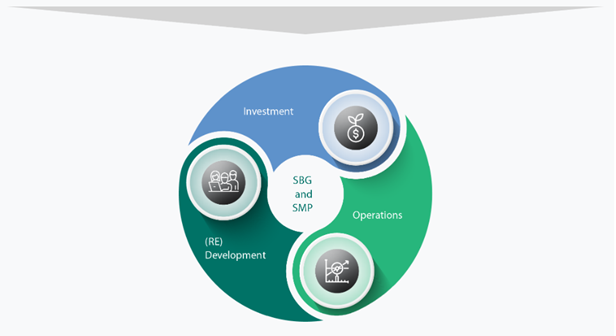
#1 Investment
- Align with CLI 2030 SMP
- Conduct Environment and Social Impact Assessment (ESIA), including the application of an internal carbon price
- Quantify proprietary Return on Sustainability (ROS)
#2 Operations
- Align asset planning with 2030 SMP targets
- Sustainable operational excellence, including sustainable procurement practices to meet the 2030 SMP targets
- Testbed innovations and collaborate with partners
- Track, evaluate and disclose performance
#3 (Re) Development
- Design in accordance with CapitaLand's SBG to meet the 2030 Sustainability Master Plan (SMP) targets
- Testbed innovations and collaborate with partners
- Track, evaluate and disclose performance
-
Environment & Social Impact Assessment (ESIA)
A key component of the SBG is the mandatory ESIA. An ESIA is carried out during the feasibility study phase for investments in operational assets or redevelopment projects as part of due diligence. This involves establishing the baseline environmental performance such as energy efficiency and comparing it against our 2030 targets. The assessment also includes transition and physical risks and opportunity considerations, as well as the application of an internal carbon price. This assessment would guide the businesses to consider EHS risks and opportunities upfront and identify mitigation measures earlier. The significant findings of the ESIA and their cost implications are incorporated in the investment paper submitted to CLINT's Board for approval.

Policies

Policies
-
Fraud, Bribery and Corruption (FBC) Risk Management Framework
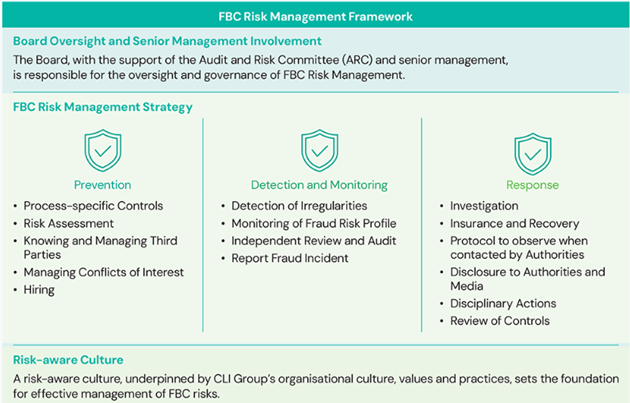
The Manager has a longstanding zero-tolerance stance against FBC in the conduct of its business activities and expects all its employees to be committed to the highest standards of integrity in their work and business dealings. The Manager's employees adhere to CLI's FBC Risk Management Policy which is published on CLI's intranet and is accessible by employees. The policy reiterates the strong stance against fraud, bribery and corruption and sets the overarching approach and standards for managing FBC risks in an integrated systematic and consistent manner. This stance is also reiterated during its regular staff communication sessions.
-
Whistleblowing Policy
A whistleblowing policy and other procedures are put in place to provide the Manager's employees and parties who have dealings with the Manager with well defined, accessible and trusted channels to report suspected fraud, corruption, dishonest practices or other improprieties in the workplace, and for the independent investigation of any reported incidents and appropriate follow up action. The objective of this policy is to encourage the reporting of such matters so that employees or external parties making any reports in good faith will be able to do so with the confidence that they will be treated fairly and, to the extent possible, be protected from reprisal. The Audit and Risk Committee (ARC) reviews all whistleblowing complaints at its scheduled meetings. Independent, thorough investigation and appropriate follow up actions are taken. The outcome of each investigation is reported to the ARC. All employees of the Manager are informed of this policy which is made available on CapitaLand Group's intranet and on this website.
Click here to view the Whistleblowing Policy.